
Dressmaker style tags and requirement rules
A commission asks for a feel, written as style tags with numbers: Gothic 40, Romantic 25. The dress gets its tag scores from the pieces you sketch and the fabric you choose, and the sketchbook adds them up for you before you cut anything.
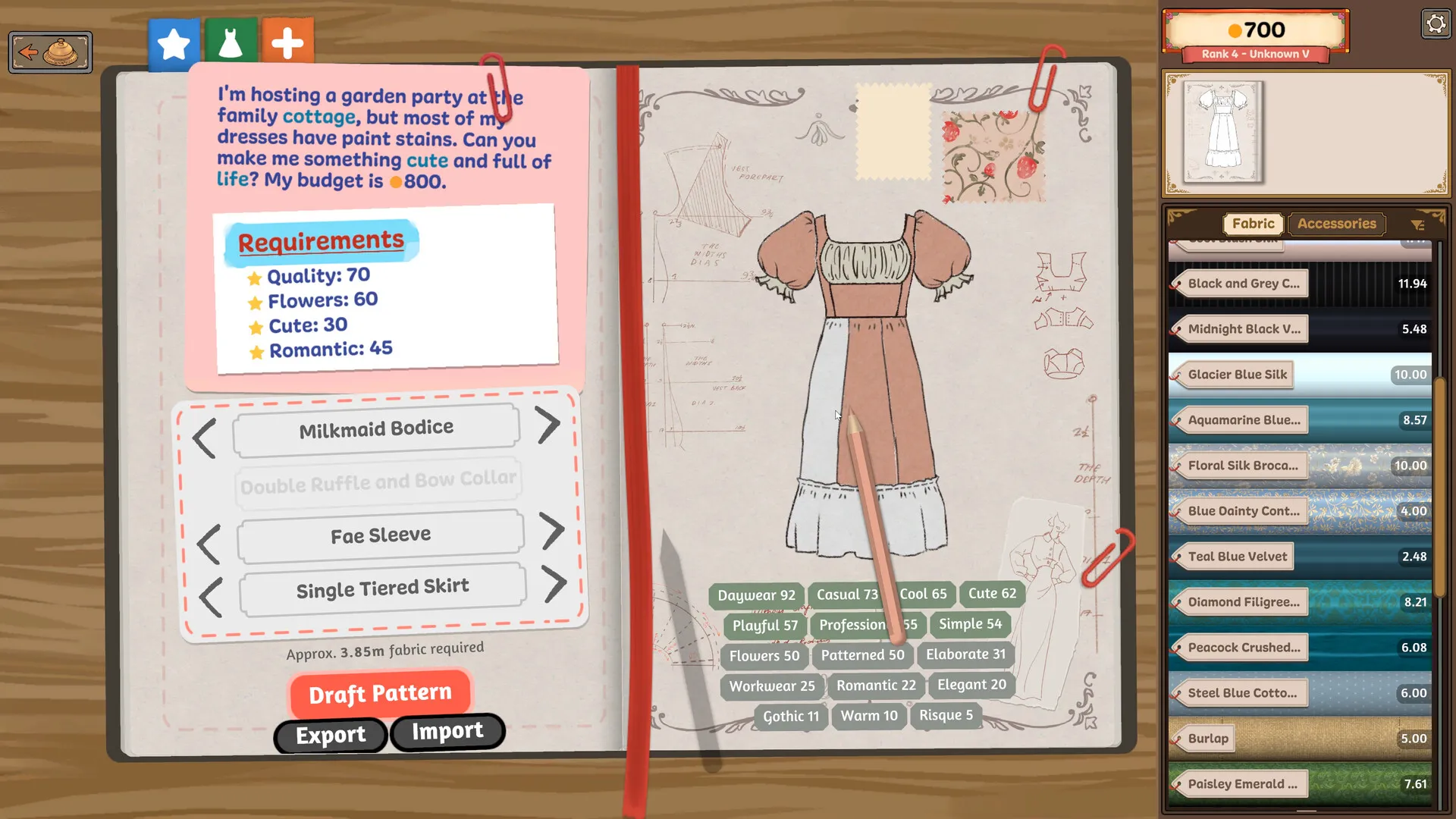
Where tag scores come from
Each dress piece and each fabric carries tag scores. Fabrics show theirs in the shop and on the cutting table. The two fabrics in this site’s screenshots, with their current scores:
| Fabric | Material | Tag scores |
|---|---|---|
| Strawberry Fields Simple Cotton | Cotton, Pink | Flowers 100, Patterned 100, Casual 50, Cool 50, Daywear 50, Cute 50, Playful 50, Workwear 50, Romantic 25 |
| Dusty Pink Silk | Silk, Pink | Simple 50, Elegant 50, Formal 50, Romantic 50, Cute 50, Eveningwear 50, Playful 50, Cool 25, Glamour 25, Eclectic 10 |
There are over 450 fabrics, over 150 dress pieces and over 350 accessories, so the practical way to hit a number is to add fabric swatches to the sketch and watch the scores move. To find the fabric with the most of a tag, use the fabric finder.
The 22 tags
These are the tags the sketchbook lists. The number beside each is how many cards on the commission finder ask for it; tap a tag to see those cards.
- Gothic 18
- Glamour 17
- Romantic 17
- Cute 16
- Elaborate 16
- Playful 16
- Elegant 13
- Risqué 13
- Daywear 10
- Formal 10
- Eclectic 9
- Eveningwear 9
- Patterned 9
- Simple 7
- Warm 7
- Professional 6
- Cool 5
- Flowers 5
- Workwear 4
- Uncomfortable 1
- Casual 0
- Shimmering 0
Requirement rules, and how to read them
| Rule on the card | Example | Plain reading |
|---|---|---|
| Tag: N | Professional: 40 | the dress scores at least N in that tag |
| Tag: at most N / Tag (Max) | Cute: at most 20 | a ceiling: N or less |
| Avoid: colour | Avoid: Black | no fabric in that colour |
| Use only: colours | Use only: Grey, Black, Brown | every fabric in one of the listed colours |
| Colour: at least N% | Black: at least 50% | that share of the dress in the colour |
| Fabric: at least N% | Velvet: at least 50% | that share of the dress in the material |
| Accessory: at least N | Brooch: at least 1 | that many of the accessory placed |
| Use Ncm of Lace Trim | Use 100cm of Lace Trim | that length of trim tagged as lace trim |
| Different colours: at least N | Different colours: at least 3 | that many colour tags across your fabrics |
A ceiling is the rule that catches people out, because a good dress can overshoot it. The first card with one is Rose’s second, and keeping Chilly Overtime under Cute 20 walks through it.
Goat Mediation: why Formal can turn red
Goat Mediation sets Formal to at most 40. The number is a ceiling. More Formal points can make this requirement fail.
| Example Formal score | Compared with the cap |
|---|---|
| 40 | Passes this requirement |
| 50 | Too high: change pieces or fabrics to reduce Formal |
Passing the Formal ceiling still leaves the card’s other requirements to check.
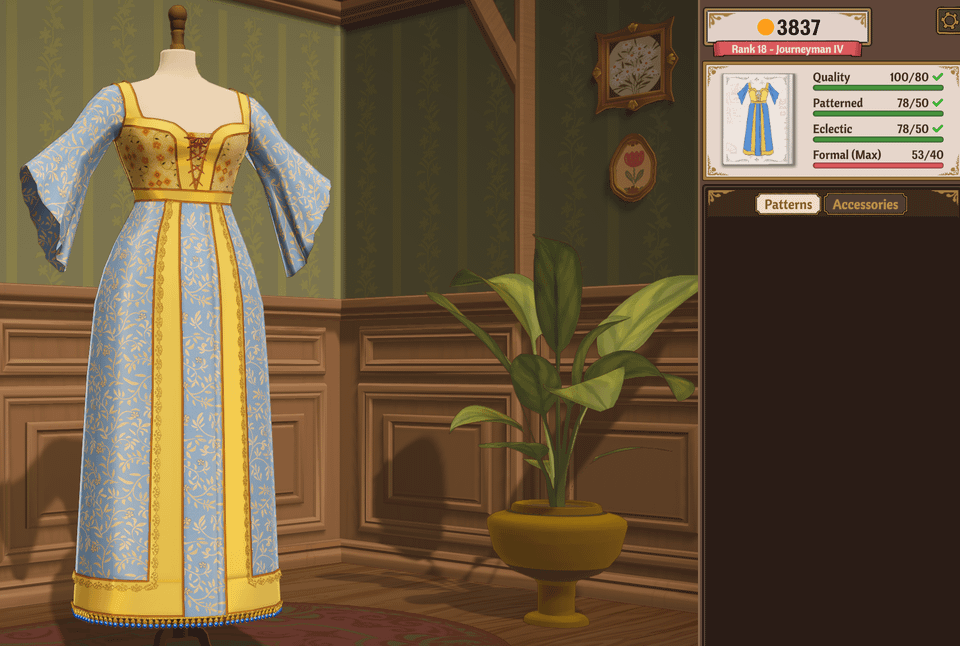
A separate modelled example shows why changing one part can help: keep a Sunset Hibiscus Silk Puffy Gathered Tiered Skirt and replace a Honey Yellow Silk Milkmaid Bodice with Honey Yellow Cotton. Formal falls from 55 to 32, while Patterned stays 54 and Eclectic stays above its minimum at 59. These are starting items; the shape and yellow colour tag stay the same, but the fabric surface changes.
This model is not a reconstruction or tested pass of the pictured dress. See the fabric repair, cost and Quality checks, or load the failing example to compare one-part repairs.
When a tag stops rising
Accessories lift a tag only so far. Once a tag stops moving, more of the same accessory adds nothing, and the missing points have to come from fabric, most cheaply on one small piece. The fixes, with a real panel stuck at Playful 48 of 50, are on a tag that will not go up.
How colour goals count
- Colour goals go by each fabric’s colour tags, not by what the print looks like. A multicolour print tagged Orange counts only as orange. Check a fabric’s tags before you rely on it for a colour.
- Two fabrics in the same colour category count as one colour for Different colours. Use the colour filters to see which category a fabric sits in.
- If a colour share will not move, check the fabric on layers you cannot see, such as an underskirt: they can count toward the colour %.
Dress pieces
The sketch is built from four slots: bodice, collar, sleeve and skirt. The sketch at the top of this page uses a Milkmaid Bodice, a Double Ruffle and Bow Collar, a Fae Sleeve and a Single Tiered Skirt. The ruffle skirt has its own achievement, Sew Long, for finishing it the first time. Some collars only appear with certain bodices, so if a collar is missing from the list, try a different bodice. For how friendship is thought to tie in, see the ten clients.