
How players make the Starry Night, Mona Lisa and Pokémon dresses
The famous painting dresses are not made from a painting-print fabric. The Starry Night, the Birth of Venus and the stained-glass gowns are drawn: the dress is sewn first in a pale, quiet fabric, and the picture goes on afterwards in the Accessories step, one strand of piping or trim at a time. The Bellossom dress uses the other method: a different fabric on each panel.
The dresses, and how their makers say they did it
| Dress | Method | Time |
|---|---|---|
| Starry Night | Sewn in a cream fabric, then the skirt covered in lace, piping, fringe and bead trims and brooches. The accessories alone came to 2,516 gold. | About five hours |
| Mona Lisa | By the same maker: the portrait and the landscape behind it drawn in piping and trims on the front of a white floral dress, with a leaf lace hem. | About four hours |
| Birth of Venus | Rows of piping laid side by side to fill each area of colour, on a small section of a printed dress. Its maker says a bigger section would have made the details easier. | About 12 hours |
| Stained glass | A fabric dress with the lead lines drawn over it in trim, using separate short pieces rather than one long strand to keep it from twisting. | Not given |
| Cel-shaded Alice | Every outline, sketch line and letter is black piping. | A few hours |
| Monarch butterfly | Black piping and white buttons for the dots. | About two hours |
| Bellossom (Pokémon) | No accessories: green and yellow fabric on alternate skirt panels, and layered sleeves in the flower’s colours. | Not given |
None of these makers mentions a mod. The mod route, a custom fabric, is at the end of this page.
Drawing with trim, step by step
- Pick a big, plain area. A wide skirt panel in a light solid or a faint print gives the picture room. The smaller the area, the harder the details.
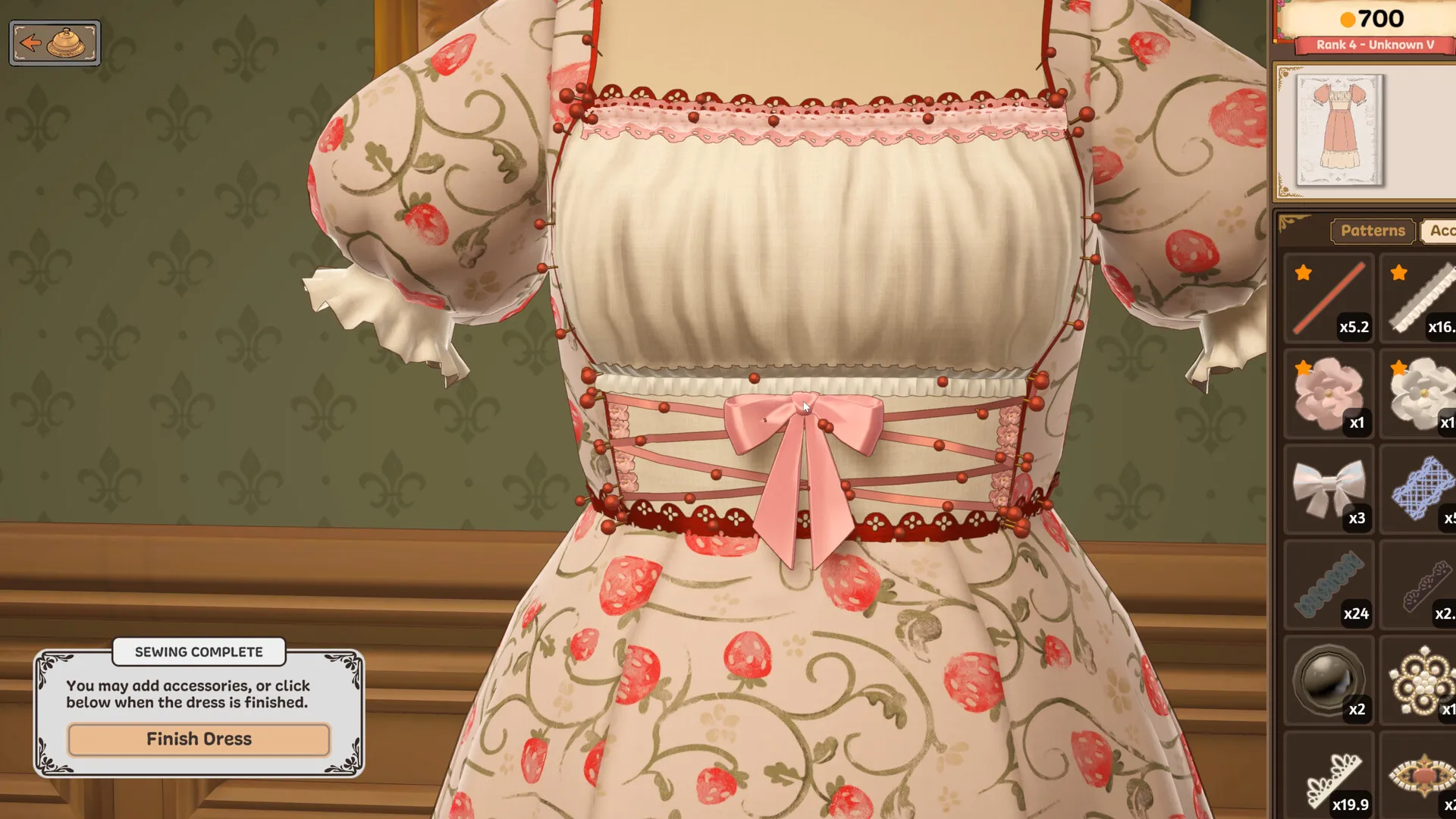
- Sew the whole dress first. The art goes on in the Accessories step, after sewing, so cut and sew for Quality as usual.
- Outline in piping. Black piping is the usual line; it is sold from the first day.
- Fill with rows. Lay more piping or trim side by side inside each outline until the area reads as one colour.
- Work in short lengths. Place a pin every few centimetres and start a new strand for each line or curve. Long strands twist around the folds of the dress.
- Finish with small pieces. Buttons, flowers, jewels and appliqués make dots, eyes and highlights.
Controls that save hours
| Trim faces the wrong way | Drag it the other way. Left to right and right to left give opposite sides. |
|---|---|
| See the picture without pins | Switch to the Patterns or fabric tab. The pins hide, but you cannot edit there. |
| Place the same piece again | Hold Shift. You keep placing the accessory at the same size, and Shift-clicking one already on the dress picks up a copy. Trims cannot be copied this way. |
| Rotate in every direction | Left Ctrl + R turns the rotation handles on and off. |
| A sleeve is in the way | Take it off while you work on the bodice, then put it back. |
| Mirror or symmetry | Not in the game itself; each side is placed by hand. The ModLoader adds a symmetry option. |
Lace that floats off the dress or will not lie flat is a known problem; what helps is under removing, resizing and floating lace. The rest of the keys are on controls.
Your line colours: 32 pipings
Piping costs 1 gold a metre in every colour. 16 colours are sold from the start and the rest arrive as your shop rank rises. For a bigger range there are 49 lace trims and many beaded, fringed and gem trims, all in the accessories guide.
From the start
 Amber
Amber Black
Black Blue
Blue Daffodil
 Honey Yellow
 Lime Green
 Mauve
Mauve Olive Green
 Pink
Pink Plum
Plum Poppy Red
 Purple
 Russet Brown
 Turquoise
 White
White Yellow
Later
 Periwinkle Blue rank 6
 Prosecco rank 6
 Bordeaux rank 7
 Crimson Black rank 7
 Wisteria rank 7
 Amethyst rank 10
 Clementine rank 10
 Viridian Green rank 10
 Taupe rank 11
 Red rank 13
 Orange rank 18
 Terracotta rank 18
 Blue Azure rank 20
 Sea Mist Blue rank 20
 Mint Green rank 29
 Sienna rank 29
Ready-made pictures: 12 appliqués
Luna Moth Appliqué, Purple Dragonfly Appliqué and Scarab Beetle Wing Appliqué are pictures in their own right, and the 9 silk leaves come in different shapes for foliage. A dress built around one is quicker than drawing everything in piping. Other small pieces for detail: 25 buttons, 31 flowers, 7 jewels and 11 brooches.
| Appliqué | Rank | Gold |
|---|---|---|
 Diamond Silk Leaf Appliqué Diamond Silk Leaf Appliqué | 1 | 3 |
 Ginkgo Silk Leaf Appliqué Ginkgo Silk Leaf Appliqué | 1 | 3 |
 Hastate Silk Leaf Appliqué Hastate Silk Leaf Appliqué | 1 | 3 |
 Oval Silk Leaf Appliqué Oval Silk Leaf Appliqué | 1 | 3 |
 Reniform Silk Leaf Appliqué Reniform Silk Leaf Appliqué | 1 | 3 |
 Heart Silk Leaf Appliqué Heart Silk Leaf Appliqué | 3 | 3 |
 Oblique Silk Leaf Appliqué Oblique Silk Leaf Appliqué | 7 | 3 |
 Luna Moth Appliqué Luna Moth Appliqué | 9 | 10 |
 Lanceolate Silk Leaf Appliqué Lanceolate Silk Leaf Appliqué | 14 | 3 |
 Purple Dragonfly Appliqué Purple Dragonfly Appliqué | 19 | 10 |
 Pinnate Silk Leaf Appliqué Pinnate Silk Leaf Appliqué | 22 | 3 |
 Scarab Beetle Wing Appliqué Scarab Beetle Wing Appliqué | 50 | 5 |
Skies, water and sunsets: the 15 gradient fabrics
For a background that fades, players use a gradient fabric instead of trim. To make it run from top to bottom you cut the piece across the grain, which on most pieces scores 75% for grain instead of 100%. Pieces the game treats as bias cut score 100% either way. Grain is 30% of a commission’s Quality, so a clean sewing score and straight grain on the other pieces make up most of it (how Quality adds up). The earliest is Blue Pansy Gradient Silk at rank 1. How gradients and prints sit on the pieces is on grain, gradients and prints.
| Gradient | Kind | Rank | Gold a metre |
|---|---|---|---|
 Blue Pansy Gradient Silk Blue Pansy Gradient Silk | Silk | 1 | 30 |
 Desert Dawn Gradient Sequins Desert Dawn Gradient Sequins | Sequin | 10 | 40 |
 Parrot Fish Gradient Silk Parrot Fish Gradient Silk | Silk | 16 | 30 |
 Mermaid Dream Gradient Sequins Mermaid Dream Gradient Sequins | Sequin | 19 | 40 |
 Frangipani Gradient Silk Frangipani Gradient Silk | Silk | 20 | 30 |
 Unicorn Gradient Silk Unicorn Gradient Silk | Silk | 27 | 30 |
 Pastel Sunrise Gradient Silk Pastel Sunrise Gradient Silk | Silk | 28 | 30 |
 Protea Gradient Sequins Protea Gradient Sequins | Sequin | 30 | 40 |
 Sanguine Smoke Gradient Silk Sanguine Smoke Gradient Silk | Silk | 36 | 30 |
 Radioactive Gradient Silk Radioactive Gradient Silk | Silk | 38 | 30 |
 Sea Witch Gradient Silk Sea Witch Gradient Silk | Silk | 39 | 30 |
 Artemis Gradient Sequins Artemis Gradient Sequins | Sequin | 45 | 40 |
 Galaxy Gradient Sequins Galaxy Gradient Sequins | Sequin | 48 | 40 |
 Blue Flame Gradient Silk Blue Flame Gradient Silk | Silk | 49 | 30 |
 Jellyfish Gradient Sequins Jellyfish Gradient Sequins | Sequin | 49 | 40 |
What a picture costs, and what it pays back
A trim’s price is its length times its price per metre, and every strand counts as one accessory. So 200 short strands of piping adding up to 20 m cost 20 gold, but they also add 200 gold of labour to the total the sale price is worked from, and 200 towards the 300 accessories of Harder than it Seams. Short strands are the better look and the better deal. Fancy trims cost far more per metre: the Starry Night’s accessories came to 2,516 gold and the dress sold for 5,234. How the sale price is worked out is on making money.
The mod route: your own fabric
With the ModLoader you can make a fabric from a PNG or JPG image (under 2,048 pixels, square works best), give it a price and tags, save it as a fabric pack, restart the game and buy it in the shop like any other. That can turn a painting into a print, but it needs the mod installed, and none of the makers above says they used a custom fabric: their pictures are trim. Installing it is covered on mods on Nexus.